
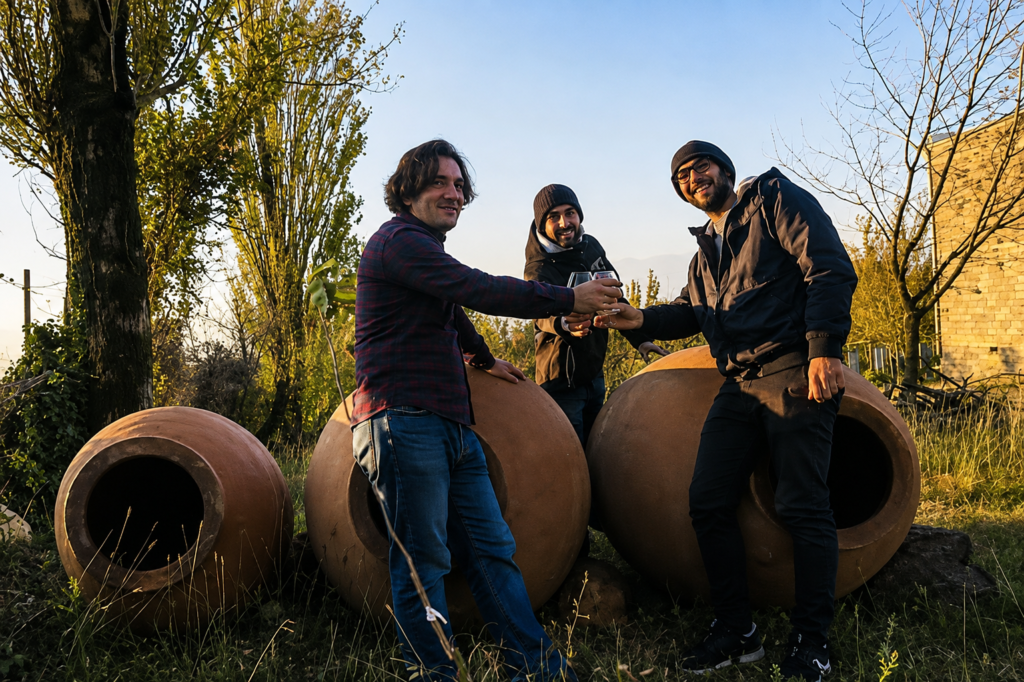
What is qvevri
A qvevri is a traditional Georgian clay vessel used to ferment, age and store wine. Its distinctive egg-shaped form and the practice of burying it in the ground are at the heart of Georgia’s ancient winemaking tradition. Qvevri have been used in Georgia for thousands of years. Traditionally, they are made by hand from local clay, fired in a kiln, and then buried in the cellar, with only the opening at the top remaining accessible. The earth surrounding the vessel helps maintain a naturally stable temperature throughout the year.
The shape of the qvevri is also important. Its rounded, egg-like interior encourages natural movement of the fermenting wine. During fermentation, grape skins and other solid parts move and circulate naturally, allowing the wine to develop structure, texture and complexity without the need for constant mechanical intervention.
The Qvevri Winemaking Process
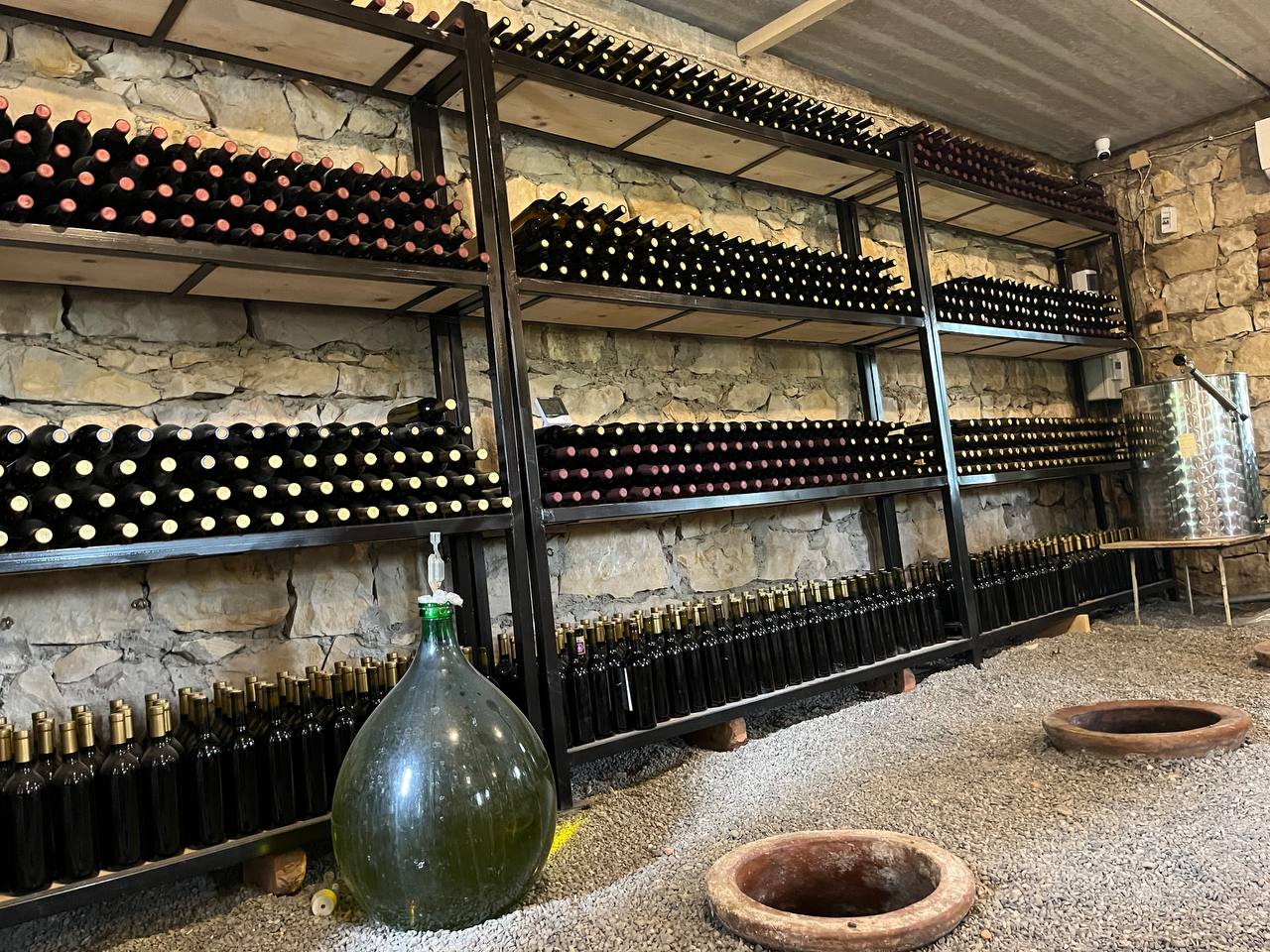
Harvest, Destemming & Pressing
The journey of our wine begins in the vineyard. Grapes are harvested by hand when they have reached the right balance of ripeness, acidity and flavor. Careful harvesting is important because healthy, undamaged grapes are the foundation of good wine.
After harvest, the grapes are brought to the cellar and carefully sorted. Depending on the grape variety and the style of wine we are making, the grapes may be destemmed, separating the berries from the stems, or some stems may be retained as part of the traditional fermentation.
The grapes are then gently crushed to release their juice. For our traditional qvevri wines, the goal is not to extract everything as quickly as possible. We want to preserve the natural character of the grapes and allow the wine to develop gradually.
The crushed grapes, together with the juice, skins and, when appropriate, stems and seeds, are transferred into the qvevri. From this point, fermentation begins and the transformation from freshly harvested grapes into Georgian qvevri wine truly starts.
Every decision at this stage matters — from the moment the grapes are picked to the way they enter the qvevri.
Fermentation in Qvevri
Once the crushed grapes are placed in the qvevri, natural fermentation begins. The juice, grape skins, seeds and, depending on the wine, stems ferment together inside the clay vessel.
During fermentation, naturally occurring yeasts transform the grape sugars into alcohol, while the skins and seeds release color, tannins and aromatic compounds. For traditional Georgian amber wines, extended contact with the skins gives the wine its characteristic golden-amber color, structure and depth.
The qvevri is buried in the ground, which helps maintain a naturally stable temperature during fermentation. This creates a gentle and consistent environment for the wine to develop. As fermentation progresses, the grape skins rise to the surface and form a cap. We regularly mix or gently push this cap down, allowing the skins to remain in contact with the fermenting wine.
We do not rush the process. Time, the qvevri and the natural character of the grapes work together to create a wine with its own identity.
After fermentation is complete, the wine remains in the qvevri for further maturation, allowing its flavors and structure to develop naturally.
Maturation in Qvevri
After fermentation, the wine remains in the qvevri to mature and develop its character. This period allows the wine to gradually become more harmonious, as its aromas, flavors, tannins and acidity come together over time.
The qvevri is buried in the ground, where the surrounding earth helps maintain a naturally stable temperature. The wine can therefore mature in a calm and consistent environment, protected from significant temperature fluctuations.
During maturation, the wine remains in contact with the fine lees and, in traditional styles, with the grape skins and seeds for part or all of this period. This extended contact contributes to the wine’s texture, structure and complexity. With time, the stronger elements of a young wine begin to soften and integrate, revealing greater balance and depth.
The winemaker’s work during this stage is mainly one of care and observation. The qvevri must be kept clean and properly sealed, while the wine is monitored as it slowly develops. Rather than imposing a particular character on the wine, we allow time and the natural environment of the qvevri to shape it.
Once the wine has reached its desired maturity, it is carefully prepared for bottling. We keep intervention to a minimum, allowing the wine to retain its natural character and the expression of the grape, qvevri and place.